Physical Address
304 North Cardinal St.
Dorchester Center, MA 02124
Physical Address
304 North Cardinal St.
Dorchester Center, MA 02124

Tattoo ideas for men range from compact first pieces to full sleeves and back compositions. The strongest choices begin with meaning, anatomy, visibility, and a style that suits the subject—not a list of supposedly masculine symbols.

Original editorial illustration created for TattoosIdeas.ink. It is a concept visual, not a photograph of a tattoo or a tattoo stencil.
Men’s tattoos are not a single aesthetic. The category covers black-and-grey realism, American traditional, Japanese work, blackwork, geometric designs, fine line, lettering, and mixed patchwork collections. Searchers commonly compare forearm tattoos for men, meaningful designs, small first tattoos, arm tattoos, chest pieces, and sleeve concepts. A useful guide should explain how each option fits the body and lifestyle.
Popular motifs stay popular because artists can reinterpret them. Treat every symbol as a starting point rather than a ready-made stencil.
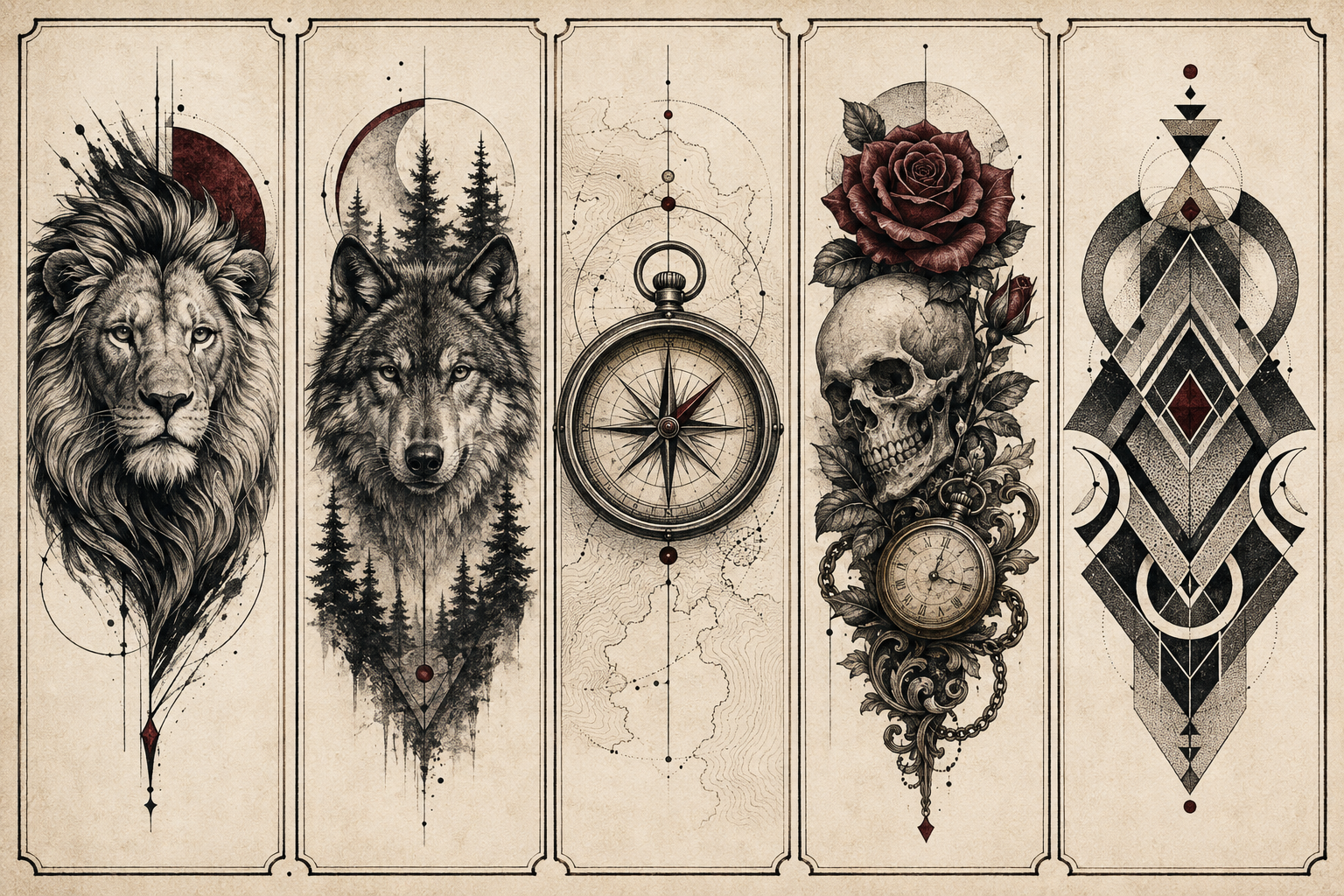
The forearm is popular because it offers a relatively flat canvas and can display vertical designs clearly. The upper arm and shoulder suit rounded compositions and can grow into a half sleeve. Chest and back placements provide more space for meaningful narrative work, while hands and neck are high-visibility commitments. Consider work requirements, sun exposure, friction, future expansion, and whether you want the tattoo to remain private.
Choose an artist whose portfolio already contains the style you want. A realism specialist and a traditional tattooer solve line weight, shading, and composition differently. Bring references, explain what each one communicates, and let the artist adjust scale and flow. If you may build a sleeve later, say so before placing the first piece so valuable connecting space is preserved.
The forearm, upper arm, shoulder, and calf offer useful space and are easier to cover than hands or neck. Comfort varies, so discuss placement with your artist.
Not necessarily. It should be large enough for the planned detail to remain readable after healing and aging.
Choose anchor pieces, establish a theme or visual language, and leave intentional space for transitions and background.
Continue with our guides to women’s tattoos, minimalist tattoos, small tattoos, fine-line tattoos, sleeve tattoos, traditional tattoos, Japanese tattoos, and matching tattoos.